The Artisanal Web
Craft, humanity, and our new robot overlords.
I've been on the web for a long time. Like, ever since paleolithic times. When I started doing this, Amazon was about to launch, Google was still several years away, and Zuckerberg was about to turn 10.
Back then, we were building web sites with sticks and mud and hoping to discover fire. Sticks and mud were what we had. You opened a text editor, typed some HTML, uploaded it to a server, and you had a website. If you were a cowboy caveman — and I was — you might edit the files live on the server and hope nothing broke.
But what that meant was that every website was lovingly hand-crafted by someone who was willing to put in the work. It meant almost every site was an experiment. We were all learning. "View Source" was a window into someone's craftsmanship and artistry. The best of us were idolized for that craftsmanship.
There weren't really templates or frameworks, and we were a long way from "build scripts". Sure, people would pitch the latest "WYSIWYG editor" that was supposed to make the web easier than mucking about in sticks and mud, but we all knew -- or at least those of us who knew, knew -- that they made nasty, gnarly code that was impossible to debug later. So we stuck to our sticks and mud.
No one was particularly optimizing for engagement or time-on-site or conversion. People made websites because they had something to say, or something to show, or just because they could. The web was weird and slow and full of bad tiled backgrounds, bad fonts and dumb ideas.
It was also weirdly, wildly, wonderfully human.
Then we built factories.
It made sense. You can't play with sticks and mud forever, and the hand-crafted web couldn't last. Businesses needed scale. Developers wanted better tools. Everyone wanted to do more. So we built tools that could do more, faster — suddenly there were all these new frameworks, CMSes, JavaScript libraries, and templates. You could build faster, bigger, more consistently. We industrialized the craft.
I was right in there. Twenty years ago I personally created a custom CMS that's still in production today. That's kind of amazing to me.
Anyways, we quickly moved from a hand-crafted web to a mass-production web. There was a lot of upside to that.
But slowly something started to flip. Industrialism has a logic of its own, and it doesn't stop. The tools became less interested in serving communities and more interested in serving growth. Monetization became the whole point, rather than craft, or communication, or anything else. Platforms expanded, entrepreneurs chased scale, and we learned that the real money wasn't in making things for people — it was in harvesting people.
Welcome to the machine
So we learned how to harvest people. Content stopped being something people made because they had something to say. It became something to be endlessly indexed, ranked, and monetized. It became bait, with SEO content farms and viral marketing driving the discourse and feeding The Feed, where we found ourselves endlessly scrolling, endlessly empty.
Surveillance advertising. Engagement algorithms. Infinite feeds. We stopped being the audience and became the product, and most of us barely noticed because the product was free and pretty convenient.
Which brings us to today, and a web that is no longer built for you, or for me. It's built for the machines. Most of what happens online now is measured, optimized, and fed back into systems that decide what gets seen and what doesn’t. You and I mostly exist as inputs: things to be tracked, monetized, and fed into the gears. The only thing we're good for is the ways in which we might be exploited and manipulated, whether that's financially or emotionally.
I want to be clear: this isn't a screed against AI. Like most folks these days, I use it. A lot. And this trend can't be laid at the non-existent feet of AI: we've been moving in this direction for more than 20 years. A lot of very smart, very talented people have made themselves very rich doing it, because they could. And because they found getting rich more rewarding than making something good.
AI has accelerated the trend, but we did this to ourselves. We strip-mined one of the greatest resources humankind has ever created until we were left with little but a barren hole.
This ugly bend of history left a lot of folks disgusted enough to quit tech altogether. "Leaving it all behind to become a farmer/woodworker/baker/brewer" has become a cliche for a good reason. A lot of good folks did just that. The web of today is not what they signed up for.
I could have been one of them. God knows I see the value in doing something lasting with your hands. I mean, look around this site.
And yet
I stayed. I still cared about the craft, and I still found ways to tinker with interesting things. I'm not the only one. We humans are resilient. We like to build. We like to share. We're going to keep doing those things no matter how much the industry tries to consolidate the web.
There are still people building the web by hand, very much like we did it in the early days. They know all about what's possible using modern tooling, yet they choose to expend their time and attention to the craft of doing it by hand. They care about the craft, and they care about what they're making. They believe in their unique skill and vision over engagement strategies and analytics and content algorithms. They don't need a platform, or they'll build their own.
Are these sites "better" than the current default state of the web? That depends on your definition of "better" and "for whom", and on the skill and craft of the people making the site. But no matter what, these artisanal sites have a voice. They have edges. They don't look and sound like everything else. Someone's fingerprints are all over them. These sites are, to borrow from the Iron Giant, what they choose to be.
That used to be the default. That used to just be called "having a website." Now it's an act of defiance. Now it's a political act.
There's something genuinely countercultural about rejecting massive platforms, tech surveillance, and optimized algorithms: you are choosing to operate outside the norms, outside the system that the web has become. You're not feeding the machine. You're building for your self. You're making something because you want to make it, on your own terms, and you're putting it where anyone can find it, if they want to.
Maybe you just want to share on your own terms. Maybe you just want to keep practicing the craft after all these years.
That's a throughline here on this site, both in how I make the site and what I choose to share. I like to make things. I like to fix things. I like to share those things. I am more than another nickel for some algorithm vendor. And so are you.
I'm not trying to grow the site. I'm not particularly interested in monetizing it. I'm not following SEO content-optimization rules to maximize reach. I'm just making something because I want to make it, and I hope people like it. The same way I did in 1994 with a text editor and a dial-up connection.
Still, the web as a whole isn’t going back to lovingly hand-crafted sites. That world is gone. The factories won. Pushing back against the tide won't change the waterline. In fact, the tide (and the algorithms) will likely punish you.
But craft traditions didn’t disappear during the industrial revolution either. They just moved to the margins. Small workshops continued alongside the factories.
That’s where the artisanal web lives now.
If you care about becoming an influencer, you have to play the platform game. There are plenty of courts for that sport.
But if you’re not really interested in playing the game — if you just want to make things because making things matters — the craft tradition is still there.
Thankfully I'm not the only one thinking this way. There are a lot of us opting for the "small workshop" model. Matthias Ott has been championing personal sites for some time, and he maintains the Own Your Web newsletter. Andy Bell has catalogued nearly 900 artisanal web sites over on personalsit.es. Even webrings are making a quiet comeback. RSS, declared dead a dozen times, keeps getting rediscovered by people who want to follow humans instead of algorithms.
Amidst all the commoditization there are small human spaces out there, waiting to be discovered, with people working diligently and with care in them.
It's not a movement, so much as just people who still love what it feels like to make something simply because they wanted to make it.
Seek them out. Make something weird and wonderful of your own, if you're so inclined.
That's enough. It always was.
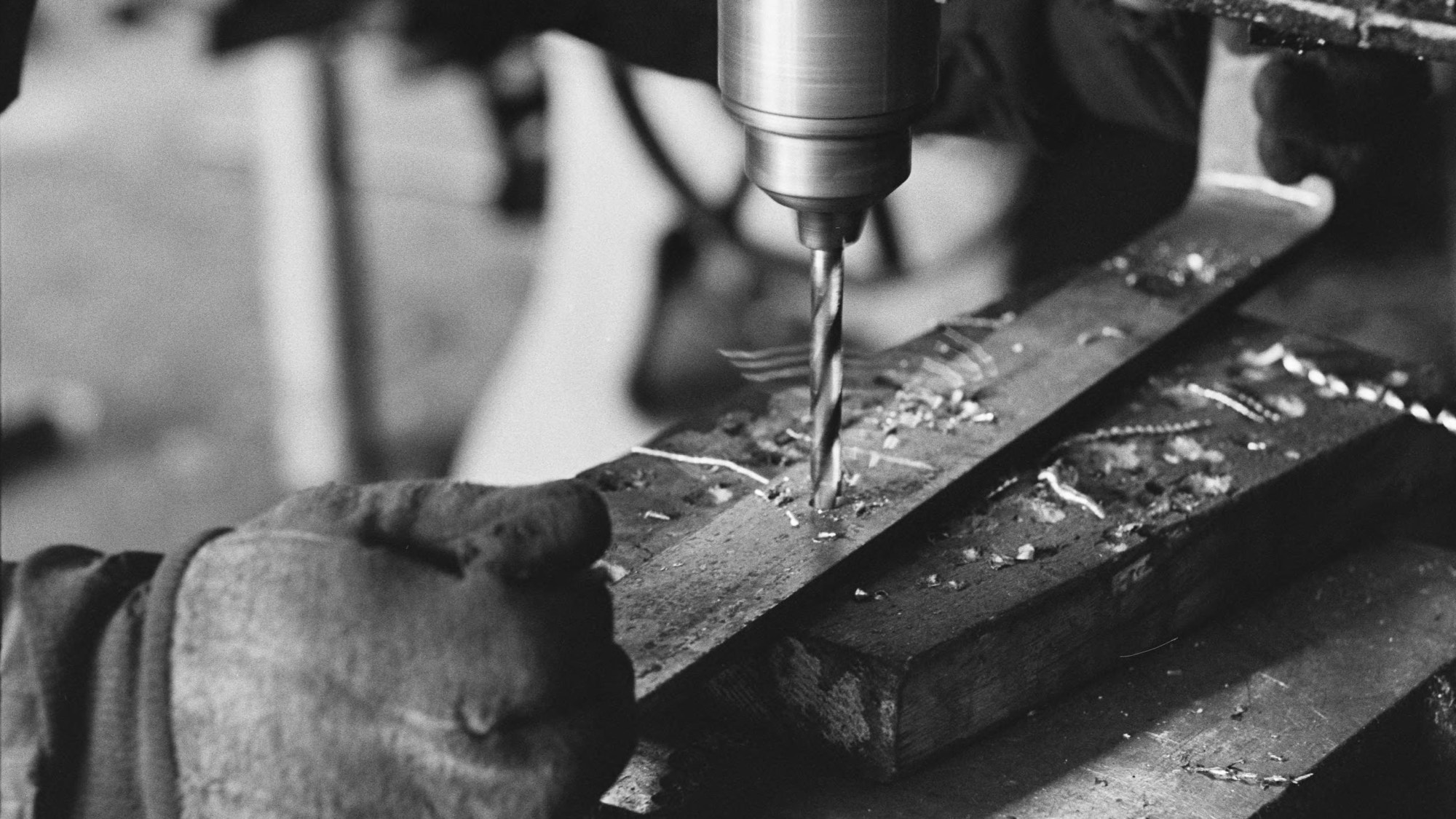
Photo is "William Snedigar, blacksmith, Stevensville, Montana", from the Library of Congress.
Have something you'd like to say about this? Let me know! | Published in Writing